Genesis 19
1Now the two angels arrived at Sodom in the evening, and Lot was sitting in the gateway of the city. When Lot saw them, he got up to meet them, bowed facedown, 2and said, “My lords, please turn aside into the house of your servant; wash your feet and spend the night. Then you can rise early and go on your way.” “No,” they answered, “we will spend the night in the square.”
3But Lot insisted so strongly that they followed him into his house. He prepared a feast for them and baked unleavened bread, and they ate.
Genesis 19:3 Commentary
Scripture’s First Mention of Unleavened Bread:
Lot bakes unleavened bread for his guests, marking the first appearance of Matzah in the biblical text. Stack the details of this scene together and a striking pattern emerges: foot washing, unleavened bread, protection inside a house during coming judgment, and a righteous family brought safely out of a doomed city just before destruction falls. First Corinthians 5:7–8 later ties this exact cluster of imagery directly to the gospel: “Messiah, our Passover lamb, has been sacrificed… let us therefore celebrate the festival… with the unleavened bread of sincerity and truth.”
Unleavened Bread Demands Breaking With Sin:
The Days of Unleavened Bread picture coming out of sin — an urgent, complete break from corruption. Ancient Jewish Midrash (Genesis Rabbah 48:12) specifically notes that this entire rescue took place at the season of Passover. Moreover, by recording that the angels physically ate this unleavened meal, Scripture reaffirms that these heavenly messengers operated bodily in our physical space to execute this literal deliverance.
4Before they had gone to bed, all the men of the city of Sodom, both young and old, surrounded the house. 5They called out to Lot, saying, “Where are the men who came to you tonight? Send them out to us so we can have relations with them!”
Genesis 19:5 Commentary
Hebrew “Yada” Exposes Predatory Intent:
The men of the city, both young and old, surround Lot’s house demanding, “Where are the men who came to you tonight? Send them out to us so we can have relations with them!” The Hebrew word used here is yada (“know”), carrying the exact same sexual meaning it carried back in Genesis 4:1, “Adam knew Eve, his wife, and she conceived.” The men of Sodom are demanding to sexually violate the visitors, whether or not they realize they are angelic beings. This is the entire city, young and old alike, mobilized for gang rape at the door of a private home. Read the text plainly for what it describes.
6Lot went outside to meet them, shutting the door behind him. 7“Please, my brothers,” he pleaded, “don’t do such a wicked thing, any of you! 8Look, I have two daughters who have never slept with a man. Let me bring them out to all of you, and you all may do to them as seems good in your eyes. But do not do anything to these men, for they have come under the protection of my roof.”
Genesis 19:8 Commentary
Sodom Had Already Rotted Lot’s Moral Compass:
Lot’s response is genuinely horrifying: he offers his own two virgin daughters to the mob in the visitors’ place. Sodom had already rotted Lot’s moral compass long before this night — years of sitting comfortably inside a wicked city had already done its work on his judgment. Scripture records this monstrous compromise to show you exactly what happens when you pitch your tent toward wickedness: your own family pays the price. Nothing about this suggestion is endorsed by Scripture. It is a desperate, sinful proposal from a compromised man.
Peter Still Calls Him “Righteous Lot”:
And yet, remarkably, two millennia down the road in the apostolic writings, the Apostle Peter in 2 Peter 2:7–8 still describes him as “Lot, a righteous man distressed by the depraved conduct of the lawless.” Scripture does not airbrush Lot’s compromises, but it records that his inner spirit was tormented daily by what he saw and heard in that corrupt city.
Judges 19 Replays Sodom at Gibeah:
Looking ahead over six centuries in Israel’s history during the era of the Judges, the tragic parallel in Judges 19:1–30 is chillingly deliberate. In that chapter, a Levite and his concubine are taken in for the night at Gibeah, in the tribe of Benjamin, and the men of the city surround the house demanding to sexually violate the guest (Judges 19:22). The host reacts almost word-for-word like Lot, begging them not to act wickedly while offering his virgin daughter and the concubine instead (Judges 19:23–24). God’s own covenant people inside the Promised Land had become indistinguishable from Sodom. Scripture records the gruesome parallel twice so no one can miss the warning: the exact same rot will devour any community that abandons God’s moral boundaries.
9“Get out of the way!” they replied. And they declared, “This one came here as a foreigner, and he is already acting like a judge! Now we will treat you worse than them.” And they pressed in on Lot and moved in to break down the door.
10But the men inside reached out, pulled Lot into the house with them, and shut the door. 11And they struck the men at the entrance, young and old, with blindness, so that they wearied themselves trying to find the door.
Genesis 19:9–11 Commentary
’Acting Like a Judge’ Is Still the Go-To Insult:
The mob turns on Lot himself, sneering, “This one came here as a foreigner, and he is already acting like a judge!” — a familiar accusation still leveled today at anyone who dares call sin what it is. Fast-forward two millennia to the New Covenant: Yeshua in John 7:24 instructs believers to “judge with right judgment,” and the Apostle Paul in 1 Corinthians 2:15 states plainly that “the spiritual man judges all things.” Believers are entirely capable of judging matters righteously; what Scripture condemns is hypocritical judgment, not moral discernment itself.
Supernatural Blindness Strikes the Mob:
The angels pull Lot back inside and strike the men at the door with blindness, “young and old” (literally “small and great”), so that they wear themselves out groping for the doorway. This judicial judgment recurs over a millennium later during the era of the kings in 2 Kings 6:18, where Elisha prays an entire Syrian army into blindness, and again two millennia later in the apostolic era in Acts 13:11, where Elymas is struck blind for opposing God’s work. The Hebrew word for this blindness, Sanverim, appears only in these two passages in the entire Old Testament — here in Genesis 19:11 and over a thousand years down the line in 2 Kings 6:18—so the Elisha episode isn’t just similar. It is the same word.
12Then the two men said to Lot, “Do you have anyone else here—a son-in-law, your sons or daughters, or anyone else in the city who belongs to you? Get them out of here, 13because we are about to destroy this place. For the outcry to YAHWEH against its people is so great that He has sent us to destroy it.”
14So Lot went out and spoke to the sons-in-law who were pledged in marriage to his daughters. “Get up, all of you,” he said. “Get out of this place, for YAHWEH is about to destroy the city!” (But his sons-in-law thought he was joking.)
Genesis 19:12–14 Commentary
Lot’s Sons-in-Law Scoff at the Warning:
Lot goes out into the night to warn his future sons-in-law — men betrothed to his daughters — urging them to flee before YAHWEH destroys the city. But to them, the warning sounds absurd; they mock him as though he were joking. That deadly scoffing foreshadows what the Apostle Peter two millennia later warns will mark human nature at the end of the age (2 Peter 3:3–4): masses of people laughing off warnings of divine judgment right up until catastrophic reality hits them.
15At daybreak the angels hurried Lot along, saying, “Get up! Take your wife and your two daughters who are here, or you will be swept away in the punishment of the city.” 16But when Lot hesitated, the men grabbed his hand and the hands of his wife and his two daughters. And they led them safely out of the city, because of YAHWEH’s compassion for them.
Genesis 19:15–16 Commentary
Dragged to Safety by Sovereign Mercy:
Only Lot, his wife, and his two unmarried daughters actually leave the city; the sons-in-law who mocked the warning stay behind and are lost. Lot himself lingers even after the warning is given, likely still torn over family left behind, and the angels are finally forced to physically grab his hand and the hands of his wife and daughters to drag them out. YAHWEH’s mercy, not Lot’s own decisiveness, gets this family out alive.
17As soon as the men had brought them out, one of them said, “Run for your lives! Do not look back, and do not stop anywhere on the plain! Flee to the mountains, or you will be swept away!”
Genesis 19:17 Commentary
Never Look Back at What God Condemns:
“Run for your lives! Do not look back,” the angels command. Looking all the way to the end of the biblical story, Revelation 18:4 issues the identical warning about the end-time system pictured as Babylon: “Come out of her, My people, so that you will not share in her sins or contract any of her plagues.” Incomplete separation from a corrupt culture always leaves you vulnerable to its destruction.
18But Lot replied, “No, my lords, please! 19Your servant has indeed found favor in your sight, and you have shown me great kindness by sparing my life. But I cannot run to the mountains; the disaster will overtake me, and I will die. 20Look, there is a town nearby where I can flee, and it is a small place. Please let me flee there—is it not a small place? Then my life will be saved.”
21“Very well,” he answered, “I will grant this request as well, and will not demolish the town you indicate. 22Hurry! Run there quickly, for I cannot do anything until you reach it.” (That is why the town was called Zoar.) 23And by the time the sun had risen over the land, Lot had reached Zoar.
Genesis 19:18–23 Commentary
Lot Negotiates His Escape Route to Zoar:
Even as fire is about to rain from heaven, Lot stops to negotiate his evacuation route. Instead of fleeing to the safety of the mountains as commanded, he pleads to escape to the nearby town of Zoar, arguing the mountain trek is too strenuous. The angels grant his frantic plea. Zoar, literally meaning “little” or “insignificant,” was part of the fertile plain earlier surveyed in Genesis 13:10, and over six centuries later Moses gazed across at this very town from Mount Nebo on the edge of the Promised Land (Deuteronomy 34:3).
24Then YAHWEH rained down sulfur and fire on Sodom and Gomorrah—from YAHWEH out of the heavens.
Genesis 19:24 Commentary
Two Divine Persons in Genesis 19:24:
Genesis 19:24 records one of the most profound theological statements in the entire Torah: "Then YAHWEH rained down sulfur and fire on Sodom and Gomorrah — from YAHWEH out of the heavens." Read that verse carefully: one divine Person physically present on earth calls down fire from YAHWEH in the heavens, demonstrating the plurality of persons within the divine Godhead centuries before the New Testament.
Divine Plurality Stamped Across the Torah:
One YAHWEH rains fire down from another YAHWEH, both named in the same breath, both fully God, one acting on the earth and one remaining in heaven. Scripture points here to two divine Persons, consistent with everything already established from Genesis 1:26 forward. Genesis 19:24 stands as evidence against any teaching that this kind of plurality only appears in the New Testament.
Zechariah Confirms — YAHWEH Sent by YAHWEH:
Genesis 19:24 isn’t a one-off. Over fifteen centuries later in the post-exilic era, the prophet Zechariah records in Zechariah 2:8–11 that the speaker says YAHWEH of hosts has sent him, and then declares, “I will dwell among you,” telling the people they will know that YAHWEH of hosts has sent him to them. Likewise, over a thousand years down the road, the prophet Hosea recorded in Hosea 1:7 where YAHWEH declares, “I will save them by YAHWEH their God.” In both, one YAHWEH is speaking about another. That is the same pattern Genesis 19:24 gives you, and it is the pattern you meet when the Word comes in the flesh to dwell among His people.
25Thus He destroyed these cities and the entire plain, including all the inhabitants of the cities and everything that grew on the ground.
26But Lot’s wife looked back, and she became a pillar of salt.
Genesis 19:25–26 Commentary
Sodom and the Entire Plain Obliterated:
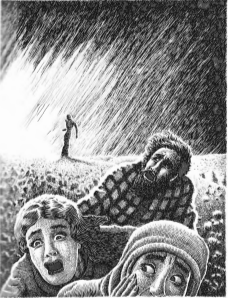
The devastation is total: every city, the entire Jordan plain, all their inhabitants, and even the vegetation growing from the ground are obliterated in an instant. Nothing survives. When divine judgment finally falls on unrepentant wickedness, it leaves neither root nor branch behind.
A Fatal Backward Glance Toward Sodom:
Lot’s wife, against the direct command she’d just received, looks back toward the city and becomes a pillar of salt. Two millennia later in the Gospels, Luke 17:32 preserves Yeshua’s urgent warning permanently: “Remember Lot’s wife.” Believers are warned, through her, never to cling emotionally to the sinful world they’ve been called out from, even after they’ve physically walked away from it. Physical distance from Sodom didn’t save her. Her heart never actually left.
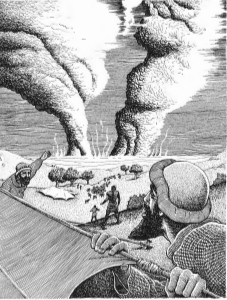
27Early the next morning, Abraham got up and returned to the place where he had stood before YAHWEH. 28He looked down toward Sodom and Gomorrah and all the land of the plain, and he saw the smoke rising from the land like smoke from a furnace.
29So when God destroyed the cities of the plain, He remembered Abraham, and He brought Lot out of the catastrophe that destroyed the cities where he had lived.
Genesis 19:27–29 Commentary
Sodom’s Smoke Previews the Fall of Babylon:
Abraham looks out and sees the smoke rising from the destroyed valley like smoke from a furnace (Genesis 19:28) — the exact imagery the Apostle John over two millennia later in Revelation applies to end-time Babylon, where kings mourn as they see the smoke of her burning when her judgment falls suddenly in a single hour (Revelation 18:9–10).
Yeshua Warns — The Days of Lot Return:
Looking ahead two millennia to the Gospels, the cross-reference to Luke 17:20–37 provides the prophetic punchline. Yeshua warns that just as in the days of Lot, people were casually eating, drinking, buying, selling, planting, and building — completely oblivious — until the very hour Lot walked out of Sodom and fire rained down to incinerate them all (Luke 17:28–29). Messiah declares that the final judgment will strike the exact same way (Luke 17:30). He deliberately pairs Lot with Noah (Luke 17:26–27) — two catastrophic global interventions preceded by mundane complacency.
Peter’s Three Judgments — Angels, Flood, and Sodom:
Second Peter 2:4–8 strings three Genesis episodes together like beads on a string. God did not spare the angels who sinned, but cast them into Tartarus (2 Peter 2:4). He did not spare the ancient world, but saved Noah, a herald of righteousness, with seven others (2 Peter 2:5). And He condemned the cities of Sodom and Gomorrah to ashes as an example of what is coming to the ungodly, while rescuing righteous Lot (2 Peter 2:6–8). Two millennia later, the Apostle Peter reads Genesis 6, the Flood, and Genesis 19 as one continuous, connected story of judgment. Each time, God judges a world that crossed a line and rescues the righteous out of the middle of it (2 Peter 2:9).
The Modern West Drowns in Sodom’s Sins:
Sound familiar? Look around. Our modern Western world is drowning in the exact same toxic cocktail: staggering wealth, endless leisure options, corrupt politicians, and a court system that cares more about bureaucratic procedure than actual justice. Worse yet, the mainstream churches are fast asleep at the wheel, happily recycling ancient pagan customs and slapping a holy label on them. It’s going to take the Almighty physically “coming down” in raw, catastrophic judgment to finally break the spell on a global scale. That same fire that fell on Sodom is, as the Apostle Peter warns two millennia later in 2 Peter 3:7, already reserved for the catastrophic close of this age. Genesis just gives you the first demonstration.
30Lot and his two daughters left Zoar and settled in the mountains—for he was afraid to stay in Zoar—where they lived in a cave.
31One day the older daughter said to the younger, “Our father is old, and there is no man in the land to sleep with us, as is the custom over all the earth. 32Come, let us get our father drunk with wine so we can sleep with him and preserve his line.”
Genesis 19:30–32 Commentary
Did Lot’s Daughters Fear Global Incineration?:
Lot and his daughters settle in a mountain cave, terrified to remain even in Zoar. His older daughter mistakenly concludes in Genesis 19:31 that no men survive on earth to marry them "according to the custom of all the earth." In Hebrew, the word Eretz can mean either local territory or the entire earth, leading some commentators to believe the daughters genuinely thought the whole world had been incinerated like the Flood of Noah.
33So that night they got their father drunk with wine, and the firstborn went in and slept with her father; he was not aware when she lay down or when she got up.
34The next day the older daughter said to the younger, “Look, I slept with my father last night. Let us get him drunk with wine again tonight so you can go in and sleep with him and we can preserve our father’s line.”
35So again that night they got their father drunk with wine, and the younger daughter went in and slept with him; he was not aware when she lay down or when she got up.
Genesis 19:33–35 Commentary
Sodom’s Corruption Follows Lot into the Cave:
The daughters get their father blackout drunk to force an heir on consecutive nights — a thoroughly premeditated scheme demonstrating how deeply Sodom’s normalized corruption had warped their moral baseline. Oblivious to what his daughters planned, Lot sits as a tragic, compromised bystander trapped in the wreckage of his own bad real estate choices.
36Thus both of Lot’s daughters became pregnant by their father. 37The older daughter gave birth to a son and named him Moab (he is the father of the Moabites of today). 38The younger daughter also gave birth to a son, and she named him Ben-ammi (he is the father of the Ammonites of today).
Genesis 19:36–38 Commentary
Moab and Ammon Anchor Modern Jordan:
The sons born from these unions become the fathers of two historic nations. In modern geographic terms, these territories sit squarely in modern-day Jordan (with Jordan’s capital, Amman, still carrying Ammon’s name today).
Settling the Ancient Land of the Rephaim:
As the historical record in Deuteronomy will reveal over six centuries later on the plains of Moab, the descendants of Lot would eventually settle east of the Jordan in territory originally occupied by giant clans. In that future historical account, Moses records in Deuteronomy 2:9–11 that Moab’s frontier had previously been home to the Emim — a giant people “great, numerous, and tall as the Anakim,” counted among the Rephaim. Likewise, the territory Ammon would inherit was known as the land of the Rephaim, where the giant Zamzummim once dwelled (Deuteronomy 2:19–21). Before Lot’s descendants could possess their inheritance, YAHWEH intervened to destroy those giant factions, just as He would later do for Israel during the conquest under Joshua. The very same hostile bloodlines encountered earlier back in Genesis 14:5 were ultimately cleared from the trans-Jordan plateau to make way for Lot’s offspring.
Ruth the Moabitess Enters the Messianic Line:
What Lot’s grown daughters did was a wicked, calculated evil, yet centuries down the road God sovereignly wove that very lineage into His redemptive plan. Looking ahead over six centuries to the Law of Moses, Deuteronomy 23:3 will bar Moabites and Ammonites from the assembly of YAHWEH for ten generations. Yet centuries after Moses in the period of the Judges, Ruth the Moabitess will embrace the God of Israel, marry Boaz, and become the great-grandmother of King David (Ruth 4:13–22)—securing an honored place in the royal genealogy of Yeshua the Messiah two millennia down the road (Matthew 1:5). A line that began in a cave, in drunken shame, ultimately ends up in the earthly lineage of the Savior. Grace goes where it wants.
Genesis 19:1–2 Commentary
Lot Holds Civic Standing in Sodom:
Two angels arrive at Sodom in the evening, and Lot, sitting at the city gate — a place reserved for elders and civic judges — rises to meet them, bows with his face to the ground, and insists they spend the night in his house. Two millennia later, the apostolic letter to the Hebrews commands: “Do not neglect to show hospitality to strangers, for by so doing some people have entertained angels without knowing it” (Hebrews 13:2).
Yeshua Commends Urgent Hospitality:
Lot presses the visitors to turn aside to his house, offering food, shelter, and protection — the exact kind of care for vulnerable travelers Yeshua would commend two millennia later in the Gospels (Matthew 25:40): “whatever you did for one of the least of these brothers of Mine, you did for Me.” Lot knew what happened to unprotected strangers after dark in Sodom.