Genesis 4
1And Adam had relations with his wife Eve, and she conceived and gave birth to Cain. “With the help of YAHWEH I have brought forth a man,” she said.
2Later she gave birth to Cain’s brother Abel. Now Abel was a keeper of sheep, while Cain was a tiller of the soil. 3So in the course of time, Cain brought some of the fruit of the soil as an offering to YAHWEH, 4while Abel brought the best portions of the firstborn of his flock. And YAHWEH looked with favor on Abel and his offering, 5but He had no regard for Cain and his offering. So Cain became very angry, and his countenance fell.
Genesis 4:3–5 Commentary
Cain’s Problem Was His Heart, Not His Crop:
Cain and Abel both bring offerings, and God accepts Abel’s but not Cain’s. Millennia later, the Apostle John unmasks the motive in 1 John 3:12: Cain murdered his brother “because his own deeds were evil, while those of his brother were righteous.” The text shows Cain held back, skipping the firstfruits and the best of what he had, while Abel deliberately brought the firstborn of his flock. Cain hands God his leftovers and expects a standing ovation for it. Giving, even here, is an act of worship, and what we offer says something about the heart behind it.
Grain Offerings Were Holy — Cain’s Attitude Was Unrepentant:
Don’t fall for the myth that God rejected Cain simply because he brought grain instead of meat. Over two millennia later at Mount Sinai, Leviticus 6:14–23 proves that grain offerings are perfectly holy to the Almighty — “this is the law of the grain offering — it is most holy,” as YAHWEH instructs Moses. The issue was Cain’s corrupt, unrepentant attitude. Thousands of years later in the prophets, Isaiah 66:3 warns that when a hypocrite brings an offering, YAHWEH counts it “like one who offers pig’s blood” — as offensive as that.
Hebrews 11:4 — Faith Followed God’s Initial Pattern:
Here’s the piece most people miss: millennia later, the writer of Hebrews, addressing Jewish believers, reveals that "by faith Abel offered God a better sacrifice than Cain did" (Hebrews 11:4) — he offered it by faith. As the Apostle Paul would likewise confirm to the Romans in Romans 10:17, faith doesn’t appear out of thin air; it comes by hearing the word of God. Put those two together and you see that God almost certainly gave this first family initial instructions on how to approach and worship Him. Abel respected the divine pattern, whereas Cain brought whatever was convenient.
Offering the Firstborn — The Heartbeat of Tithing Faith:
But Abel’s faith went even deeper than mere ritual compliance. Genesis 4:4 specifies that Abel brought "of the firstborn of his flock and of their fat portions." Think about what that actually required in an ancient agrarian setting: offering the very firstborn animal meant giving away your immediate increase before knowing whether the rest of the flock would survive, reproduce, or yield another lamb! That demanded radical, vulnerable trust that God would faithfully provide for tomorrow. This is the very heartbeat of the biblical principle of firstfruits and tithing: honoring God first with the choice portion rather than tossing Him the leftovers once your own belly is full. As God challenges His people thousands of years later through the prophet Malachi, He invites believers to step out in faith and test His generosity — to bring the full tithe and see if He will not open the floodgates of heaven to pour out a blessing beyond measure (Malachi 3:10). Abel trusted God’s provision with his very first and best, and God honored that living faith.
6“Why are you angry,” said YAHWEH to Cain, “and why has your countenance fallen? 7If you do what is right, will you not be accepted? But if you refuse to do what is right, sin is crouching at your door: It desires you, but you must master it.”
Genesis 4:7 Commentary
God’s Warning — Sin Crouches at the Door:
This is one of the most vivid, chilling warnings in Genesis: sin is personified as a predatory beast crouched at the threshold, ready to pounce and devour. Anger itself is not automatically sinful, but uncontrolled fury flings that door wide open.
Sin Crouching Proves God’s Law Existed Before Sinai:
But notice the massive doctrinal reality sitting right beneath the surface here: if sin was crouching at Cain’s door, then God’s Law was already fully operational! Looking millennia later to the Apostolic Scriptures, the Apostle John provides the only biblical definition of sin: "sin is lawlessness" — the transgression of the law (1 John 3:4). As the Apostle Paul would explain in his letter to the Romans, "where there is no law there is no transgression" (Romans 4:15), and “sin is not taken into account when there is no law” (Romans 5:13). The very fact that Cain could be warned of sin, and subsequently held guilty for murdering Abel, proves beyond dispute that God's moral commandments existed and were active centuries before Mount Sinai. Cain was not operating in a lawless moral vacuum; murder was an explicit violation of God’s eternal standard. And that truth cuts both ways: just as sin could only exist in early Genesis because God's Law was actively defining righteousness, so too if sin exists in the world today, God’s Law must still be active and binding today. You cannot discard the Law without obliterating the very definition of sin itself.
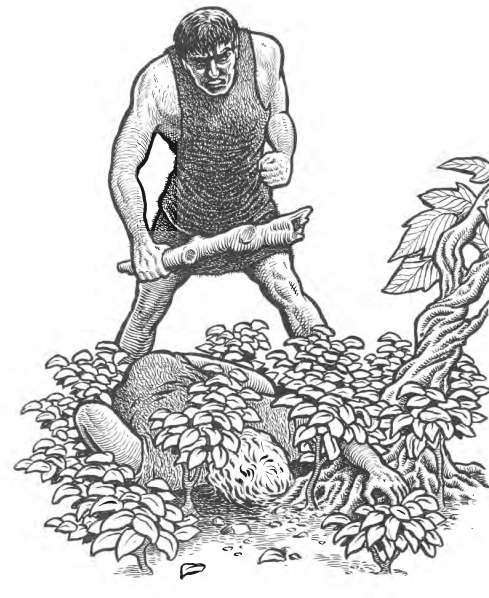
8Then Cain said to his brother Abel, “Let us go out to the field.” And while they were in the field, Cain rose up against his brother Abel and killed him.
9And YAHWEH said to Cain, “Where is your brother Abel?” “I do not know!” he answered. “Am I my brother’s keeper?”
10“What have you done?” replied YAHWEH. “The voice of your brother’s blood cries out to Me from the ground.”
Genesis 4:8–10 Commentary
Cain’s Reply Drips With Callous Defiance:
After the murder, God confronts Cain in Genesis 4:9, asking, "Where is your brother Abel?" Cain doesn’t even bother with a clever alibi, firing back with callous indifference: "I do not know! Am I my brother’s keeper?" He just murdered his own brother, and he has the nerve to get smart with the Almighty about it. That same evasive arrogance has been echoed by unrepentant sinners ever since.
Abel’s Crying Blood Is Figurative, Not Literal:
The blood crying out from the ground is vivid Hebrew idiom; blood does not literally speak from the grave. Scripture is consistent on this point from cover to cover: the dead are unconscious, awaiting a future resurrection, not wandering about in some intermediate afterlife. That claim isn’t a stray opinion — it’s the testimony of the whole Bible, front to back. Three millennia later in the wisdom literature, King Solomon in Ecclesiastes 9:5–10 states plainly that the dead know nothing and have no further part in anything done under the sun.
Yeshua and the Apostles Confirm the Dead Sleep:
Fast-forward millennia to the Gospels: Yeshua Himself calls the dead Lazarus “asleep” in John 11:11–14, and uses the same language for Jairus’s daughter in Luke 8:52–53, telling the mourners, “she is not dead but asleep.” The apostles carry the same picture forward: Paul, in 1 Corinthians 15:51–52, describes the resurrection of believers as an awakening — “we will not all sleep, but we will all be changed — in an instant, in the twinkling of an eye” — and Peter proclaims at Pentecost in Acts 2:29–34 that “David died and was buried, and his tomb is with us to this day,” for “David did not ascend into heaven.”
Abel Cries for Vengeance; Messiah Speaks Grace:
Look at the massive theological contrast underneath all of this: Abel’s blood cried out from the dirt for one thing — righteous vengeance. Because, as the Apostles would define millennia later, sin is the transgression of the law (1 John 3:4) and "the wages of sin is death" (Romans 6:23), Abel’s spilled blood justly demanded the judicial execution of the murderer. But four millennia down the line, the Epistle to the Hebrews reveals that the shed blood of Yeshua speaks a far better word than the blood of Abel (Hebrews 12:24). Abel’s blood cried out for the law’s penalty to fall upon the guilty, whereas Yeshua’s blood willingly absorbed that very penalty to extend mercy and redemption.
Messiah Redeems Us From the Curse, Not the Law:
Crucially, as the Apostle Paul would clarify millennia later in Galatians 3:13, Messiah did not die to redeem us from God’s Law; He redeemed us from the curse of the law — which is the inescapable death penalty incurred by our lawlessness! Writing to the church in Rome, Paul declares that God’s Law itself remains holy, righteous, and good (Romans 7:12). As Paul passionately argued, “Do we, then, nullify the law by this faith? Certainly not! Instead, we uphold the law” (Romans 3:31). Furthermore, keeping God’s Law today can never atone for breaking it yesterday — obedience is merely our present duty, not a retroactive eraser of past guilt. Only the shed blood of Yeshua, our Passover Lamb, possesses the power to atone for past transgressions and legally cancel our certificate of debt before the righteous Judge.
11“Now you are cursed and banished from the ground, which has opened its mouth to receive your brother’s blood from your hand. 12When you till the ground, it will no longer yield its produce to you. You will be a fugitive and a wanderer on the earth.”
13But Cain said to YAHWEH, “My punishment is greater than I can bear. 14Behold, this day You have driven me from the face of the earth, and from Your face I will be hidden; I will be a fugitive and a wanderer on the earth, and whoever finds me will kill me.”
15“Not so!” replied YAHWEH. “If anyone slays Cain, then Cain will be avenged sevenfold.” And YAHWEH placed a mark on Cain, so that no one who found him would kill him.
16So Cain went out from the presence of YAHWEH and settled in the land of Nod, east of Eden.
Genesis 4:14–16 Commentary
Cain’s Wife and the Early Human Gene Pool:
Cain fears that whoever finds him will kill him, which only makes sense if Adam and Eve already had a considerable number of children and grandchildren by this point, with families of their own beginning to form. This means Cain married his sister or niece — as confirmed in the upcoming genealogy of Genesis 5:4, where Adam and Eve had “other sons and daughters.” While centuries later at Mount Sinai Leviticus 18:9 strictly outlawed incest between siblings (“You must not have sexual relations with your sister”), it wasn’t a sin or a biological risk at the start of creation. The initial human gene pool was completely pure and free of genetic corruption for generations.
Cain’s Mark — Never About Race or Skin Color:
Whatever Cain’s mark actually was, the text never specifies. Not a single syllable in the Hebrew text supports racist myths or speculations about skin pigmentation.
17And Cain had relations with his wife, and she conceived and gave birth to Enoch. Then Cain built a city and named it after his son Enoch.
18Now to Enoch was born Irad, and Irad was the father of Mehujael, and Mehujael was the father of Methusael, and Methusael was the father of Lamech. 19And Lamech married two women, one named Adah and the other Zillah.
Genesis 4:17–19 Commentary
Two Men Named Enoch — Cain’s Line vs. Seth’s:
Worth noting: the Enoch born into Cain’s line is a completely different individual from the Enoch who “walked with God” in Seth’s line just ahead in Genesis 5:24. They shared a name, but carried completely opposite spiritual legacies.
Lamech’s Polygamy Was Never God’s Design:
A few generations later, Lamech takes two wives — the first recorded instance of polygamy in Scripture. Recall that earlier in our account back in Genesis 2:24, God had defined marriage as one man and one woman becoming one flesh. The ancient world tolerated polygamy without ever treating it as the ideal. Marriage in that world was bound up with survival, inheritance, labor, and land in ways that pushed many toward arrangements God never intended. Thousands of years later at the close of the Old Testament, the prophet Malachi reaffirms the ideal: “Has not YAHWEH made them one, having a portion of the Spirit?” (Malachi 2:15) — and in the New Testament, the Apostle Paul requires an overseer to be “the husband of but one wife” (1 Timothy 3:2), the original Edenic design reaffirmed millennia after Lamech broke from it.
20Adah gave birth to Jabal; he was the father of those who dwell in tents and raise livestock. 21And his brother’s name was Jubal; he was the father of all who play the harp and flute.
22And Zillah gave birth to Tubal-cain, a forger of every implement of bronze and iron. And the sister of Tubal-cain was Naamah.
23Then Lamech said to his wives:
“Adah and Zillah, hear my voice;
wives of Lamech, listen both of you to my speech.
For I have slain a man for wounding me,
a young man for striking me.
24If Cain is avenged sevenfold,
then Lamech seventy-sevenfold.”
Genesis 4:20–24 Commentary
Fallen Angels and the Rise of Ancient Metallurgy:
Ancient Jewish legend, reflected thousands of years later in the apocryphal and non-inspired Second Temple book of 1 Enoch, credits a fallen being named Azazel with teaching mankind weapons, armor, and metalworking. Some connect that legend to the sudden burst of technology credited to Lamech’s sons here. It carries no scriptural authority, but it lines up with the pattern of corruption spreading fast in these chapters. The book isn’t Scripture, but it shows what ancient Jewish tradition handed down about these chapters, and millennia later the New Testament epistle of Jude (Jude 14–15) even quotes Enoch’s prophecy by name.
Lamech Brags About Murder in Boastful Poetry:
This isn’t a sorrowful confession; it is unvarnished arrogance. Lamech turns up the volume on Cain’s crime and sets homicide to poetry for his wives — a chilling window into how rapidly moral rot spread in just a few generations.

25And Adam again had relations with his wife, and she gave birth to a son and named him Seth, saying, “God has granted me another seed in place of Abel, since Cain killed him.”
26And to Seth also a son was born, and he called him Enosh. At that time men began to call upon the name of YAHWEH.
Genesis 4:25–26 Commentary
Calling on YAHWEH’s Name — Two Valid Readings:
Genesis 4:26 records that at the birth of Seth's son Enosh, "people began to call upon the name of YAHWEH." The inspired text leaves this genuinely open between two readings: most naturally, this describes true worship of God taking public root; others read it as the tragic beginning of profane religious syncretism. Scripture doesn’t force a dogmatic verdict here, so neither should we.
Seth Was “Another Seed” in the Promised Line:
Seth is the third son named in the text, though not necessarily Adam and Eve’s third child overall. Eve’s words at his birth look back directly to the promise given earlier in Genesis 3:15: “God has granted me another offspring in place of Abel, since Cain killed him.” The Hebrew behind “granted” or “appointed” is Shath, playing directly on Seth’s name, Shet. Eve recognizes God actively preserving the righteous seed line through which the coming Redeemer would eventually arrive, refusing to let the serpent’s attack in Abel’s murder derail the covenant promise.
A Prophetic Gospel Encoded in Ancestral Names:
Don’t make the mistake of skipping this genealogy as a dry list of names. If you trace the Hebrew root meanings of these ten patriarchal names from Adam down through Noah — Adam (Man), Seth (Appointed), Enosh (Mortal), Kenan (Sorrow), Mahalalel (The Blessed God), Jared (Shall come down), Enoch (Teaching), Methuselah (His death shall bring), Lamech (Despairing), and Noah (Rest) — an astonishing prophetic sentence emerges: “Man is appointed mortal sorrow, but the blessed God shall come down teaching, and His death shall bring the despairing rest.” The gospel message of redemption was encoded directly into the ancestral family tree centuries before the Flood ever struck.
Genesis 4:1 Commentary
Biblical “Knowing” Means Covenant Relationship:
While traditional translations render this verse as "Adam knew Eve" (following the literal Hebrew verb yada), modern versions like the MSB translate it as "had relations with." Yet the Hebraic concept of "knowing" extends far beyond marital union or physical intimacy. Down in Genesis 18:19, God says He has "known," or chosen, Abraham — "I have chosen him, so that he will command his children and his household after him to keep the way of YAHWEH" — and centuries later in Jeremiah 31:34, the prophet describes the New Covenant the exact same way: "they will all know Me, from the least of them to the greatest," declares YAHWEH. To know God, in that fuller biblical sense, means deep relationship, intimate commitment, and covenant faithfulness, not simply possessing dry facts about Him.
Eve Likely Thought She Was Holding the Promised Seed:
Listen to what she says when Cain is born: “With the help of YAHWEH I have brought forth a man.” Eve certainly had not forgotten the promise given back in Genesis 3:15. She had been carrying the promise of a Seed who would crush the serpent since the day of the sentencing, and it is very likely that the first baby ever born looked to her like the beginning of that fulfillment. She had the right promise in mind, but whether Cain was that promised deliverer is the tragic question that unfolds across this chapter.