Genesis 6
1Now when men began to multiply on the face of the earth and daughters were born to them, 2the sons of God saw that the daughters of men were beautiful, and they took as wives whomever they chose.
3So YAHWEH said: “My Spirit will not contend with man forever, for he is mortal; his days shall be 120 years.”
Genesis 6:3 Commentary
120 Years — Human Longevity Tapered Toward Moses:
Whatever exactly unfolds in Genesis 6:2, God’s response tells you how serious it was — His displeasure is total. The hundred and twenty years mentioned here could refer either to a period of divine warning granted before the Flood struck, or to mankind’s lifespan gradually shortening; the text deliberately supports both. However, tracking the genealogical record forward makes the shortening lifespan the most likely physical fulfillment. Watch the numbers drop generation after generation from Noah (950) down through Shem (600), Peleg (239), and Abraham (175), until human longevity steadily tapers toward 120 — the exact age Moses, the human author of Genesis, dies at nearly a thousand years later at the end of the wilderness journey (Deuteronomy 34:7).
Jehoiada at 130 — Exception Proving the 120 Ceiling:
Over a thousand years later during the era of the kings, the primary scriptural exception of anyone living past 120 after Moses is Jehoiada the priest, who lived to 130 (2 Chronicles 24:15) because of his extraordinary service to God and the throne. That solitary post-Mosaic exception simply proves that 120 became a general biological ceiling, not an ironclad mathematical hard stop. It functions much like Moses’ own observation preserved nearly a millennium after the Flood in Psalm 90:10 that a man’s normal lifespan is seventy or eighty years, even while King David lived to around seventy and others occasionally pushed slightly past it.
“Angels Don’t Marry” Only Applies in Heaven:
Yet while God set a boundary on mortal human longevity in response to this crisis, what of the supernatural act in Genesis 6:2 that provoked it? Over two millennia later in the Gospels, Yeshua settles this very point in Matthew 22:29–30, explaining that angels in heaven do not marry. Notice the qualifier: in heaven. That doesn’t cover rebel angels who had already abandoned their post, which is exactly what the Apostle Jude describes millennia later in the apostolic epistles (Jude 6).
Tartarus — Ancient Abyss Reserved for Cosmic Rebels:
Beyond the catastrophic physical destruction of the global Flood that fell on humanity, the divine ringleaders of this rebellion ultimately received an even more severe supernatural sentence. The New Testament apostles leave no doubt about their fate. Millennia after the Flood, the Apostle Peter writes in 2 Peter 2:4: “For if God did not spare the angels when they sinned, but cast them deep into Tartarus, placing them in chains of darkness to be held for judgment...” The Greek verb Peter uses here is tartaroo (Tartarus) — the only time this term appears in the entire Bible. In ancient thought, Tartarus was not the common grave (Sheol/Hades), but the deepest, darkest abyss of cosmic incarceration reserved specifically for rebellious supernatural beings.
Jude 6–7 Links Angelic Rebellion to Sodom’s Transgression:
Writing millennia later in the apostolic Scriptures, Jude confirms this exact judgment in his epistle (Jude 6): "And the angels who did not stay within their own position of authority, but left their proper domain, He has kept in eternal chains under gloomy darkness until the judgment of the great day." Notice the critical connection Jude makes in the very next breath: "Just as Sodom and Gomorrah and the surrounding cities, which likewise indulged in sexual immorality and pursued strange flesh, serve as an example by undergoing a punishment of eternal fire" (Jude 7). The word "likewise" connects the sexual transgressions of Sodom directly to the sin of these fallen angels in Genesis 6 — crossing ontological boundaries to pursue flesh that was unnatural and forbidden to their kind. Unlike Satan and common demons who still roam the earth today, these Genesis 6 instigators are locked away in supernatural maximum security, awaiting final doom at the Day of the Lord.
The Spirits in Prison Are Noah’s Fallen Angels:
Millennia later in the apostolic epistles, the Apostle Peter in 1 Peter 3:18–20 tells us that the Messiah, made alive in the spirit after His death in the flesh, “went and proclaimed to the spirits in prison, because they formerly did not obey, when God’s patience waited in the days of Noah, while the ark was being prepared.” Human souls sleep in death and await resurrection, but these are spirit beings, conscious even in confinement, and Peter ties the timing directly to Noah’s generation.
Who Is NOT in Tartarus? Satan and His Angels:
Notice a critical question that immediately arises from this prison roll call: if these boundary-crossing angels were cast into Tartarus, who is NOT in Tartarus? Hearing that angels can be wicked makes some readers uneasy, yet Scripture is remarkably clear on the matter. Over two millennia later during His earthly ministry, Yeshua Himself explicitly declared in the Gospels that the eternal Lake of Fire was “prepared for the devil and his angels” (Matthew 25:41). Scripture reveals that while the vast majority of the angelic host — roughly two-thirds — remained holy and loyal to the Creator, approximately one-third eventually aligned in rebellion with Satan. As we saw in the Genesis 6:1–2 commentary, Satan was not a physical participant in this incursion and, at most, possibly coerced the angels who were.
Revelation 12 — The Future End-Times War in Heaven:
By contrast, throughout biblical history and on into the apostolic era, Satan and the one-third of rebellious angels who aligned with him were never cast into Tartarus; they remain active in the heavenly realm and the spiritual atmosphere of the earth, as recorded from the ancient book of Job to Paul’s epistle to the Ephesians (Ephesians 6:12; Job 1:6–7). Looking across two and a half millennia to the apocalyptic climax of Scripture, the Apostle John in Revelation 12 describes this active one-third participating in the great War in Heaven — an end-times event that has not yet happened! That celestial war takes place at the end of the age, after which Satan and his angels are cast down to the earth, triggering his wrath against the woman (the faithful church) who is protected in her place of safety in the wilderness for 1,260 days (Revelation 12:6, 13–14). The angels battling the archangel Michael in Revelation 12 are active in heaven until that future expulsion.
Genesis 6 Rebels Distinct From Revelation 12 Angels:
This brings us to an absolute, critical biblical distinction: the “sons of God” who crossed the boundary with human women in Genesis 6 are not part of that one-third of angels who fight in the future War in Heaven in Revelation 12. Scripture nowhere states that the rebellious angels were imprisoned in Tartarus immediately. It is entirely possible — though Scripture leaves the exact chronological timeline unspecified — that either a first group was confined and a subsequent group repeated the transgression after the Flood and was likewise confined, or that this same faction of rebel angels continued localized incursions during the early centuries following the Flood until God called an end to it and imprisoned them. What the apostolic writings reveal with certainty millennia later through Peter and Jude is that God ultimately locked these boundary-crossing spirits away in the darkest abyss of Tartarus (2 Peter 2:4; Jude 1:6, kept in eternal chains under gloomy darkness until the final judgment. As Jude’s epistle explains (Jude 1:7), they serve as an enduring, terrifying example of eternal judgment — a permanent divine deterrent that explains why, once Moses, Joshua, and centuries later David and his mighty men would finally wipe out the last remnants of the Canaanite giant clans, no Nephilim have ever appeared on earth again!
4The Nephilim were on the earth in those days—and afterward as well—when the sons of God had relations with the daughters of men. And they bore them children who became the mighty men of old, men of renown.
Genesis 6:4 Commentary
Nephilim Were Giants, Not Ordinary Human Offspring:
Then comes the detail that should stop us cold. Nephilim in Hebrew means “fallen ones,” and the Septuagint translates it plainly as “giants.” If both parties in this union were simply human, there’s no reason it would produce something the text treats as genuinely unprecedented — ordinary human marriages don’t get their own verse.
Numbers 13 — Biblical Realism on Giant Stature:
Nearly a thousand years later during the wilderness wanderings, Numbers 13:32–33 confirms the size problem: the Israelite spies come back from the land terrified, telling Moses “we seemed like grasshoppers in our own sight, and we must have seemed the same to them.” These were not normal men who happened to be six-foot-two, but they weren't 30-foot mythological beasts either. Looking ahead across biblical history for a well-documented benchmark of this stature, the Dead Sea Scrolls (4QSam-a) and the Septuagint record that Goliath of Gath stood four cubits and a span — roughly six feet nine inches. To ancient Israelites whose average height was around five-foot-three, an armored warrior pushing nearly seven feet was an absolute, terrifying giant who made whole armies freeze.
“Also Afterward” — Giant Clans Reappeared After the Flood:
Genesis 6:4 itself anticipates this: the Nephilim were on the earth “in those days — and afterward as well” — meaning this was not a one-time pre-Flood event. The same kind of localized rebellion happened again after the Flood, producing giant clans in and around Canaan: the Anakim and the Rephaim, whom Israel would later confront in the conquest, and the Emim and the Zamzummim, whom Moab and Ammon displaced. Nearly a thousand years later during the wilderness wanderings, the spies’ report in Numbers 13:33 identifies the Anakim as descendants “from the Nephilim” — a clan arising directly out of post-Flood rebellions. Moses’ retrospective forty years later on the plains of Moab in Deuteronomy 1:28, 2:10–11, and 2:20–21 likewise describes them as a people great in stature, where the Rephaim were counted as formidable giants just like the Anakim. When God commanded Israel to devote these specific Canaanite strongholds to destruction (cherem), the primary objective was not indiscriminate ethnic slaughter, but the complete eradication of these entrenched Nephilim giant clans — the Anakim and Rephaim — from the Promised Land. The decree of total warfare fell upon the precise regions where this rebel lineage had embedded itself, neutralizing a demonic threat to the human seed line and reclaiming the geographic territory promised to Abraham.
Refuting the Myth of Nephilim DNA on the Ark:
Recognizing that repeated post-Flood rebellions produced the giant clans of Canaan matters immensely, because it completely demolishes the desperate theory that those giants somehow rode out the Flood on the Ark. Some commentators resort to the bizarre claim that one of Noah’s daughters-in-law was either an actual giant Nephilim or carried some kind of “recessive Nephilim mutant gene” across the Flood! But that idea completely misunderstands why God judged the earth. Scripture never says the Flood was sent purely to eliminate Nephilim DNA; it explicitly states the Flood was sent because the wickedness of man was great, every intent of the human heart was continually evil, and the earth was filled with violence (Genesis 6:5, 11). While the demonic corruption was undoubtedly a major catalyst in that moral and societal collapse, God preserved Noah as an upright, righteous man walking with Him, whose family line remained untainted by the surrounding rebellion. To imagine that God preserved Noah’s family only to allow demon-hybrid Nephilim genetics to sneak onto the Ark through a daughter-in-law is completely baseless.
5Then YAHWEH saw that the wickedness of man was great upon the earth, and that every inclination of the thoughts of his heart was altogether evil all the time. 6And YAHWEH regretted that He had made man on the earth, and He was grieved in His heart. 7So YAHWEH said, “I will blot out man, whom I have created, from the face of the earth—every man and beast and crawling creature and bird of the air—for I am grieved that I have made them.”
Genesis 6:5–7 Commentary
Total Depravity — Man’s Heart Turned Continually Evil:
After this, corruption spreads unchecked until every human thought runs evil, all the time, grieving God to the core. This isn’t a world with a few bad actors mixed in with decent people. It is wall-to-wall depravity, and God looks at what mankind has done with His own image and regrets making him. Fast-forward millennia to the Mount of Olives: Yeshua warned in Matthew 24:38 that the end times would look exactly like the days of Noah. Look at how He describes it: they were eating, drinking, and marrying. On the surface, it looks like normal daily living, but that is the terrifying deception of sin. The world was drenched in blood and violence, yet society was so utterly desensitized that they just kept partying right up until the day the Flood swept them away.
Only a Small Remnant Stays Faithful to God:
Over two millennia later in the Gospels, this small-remnant pattern echoes through the Messiah's own teachings: few find the way that leads to life (Matthew 7:13–14), and He comforts His followers as a “little flock” precisely because they are so few (Luke 12:32).
Even the Animal Kingdom Shared in the Judgment:
God’s grief extends even to the animals, which shows corruption had spread beyond humanity alone. Looking far ahead to the prophetic vision of the ultimate restoration, the prophet Isaiah in Isaiah 65:25 describes the new heavens and new earth, picturing the lion eating straw like the ox — a complete reversal of the predatory nature that entered creation after the Fall. (Fish, notably, sit this one out — a Flood is the one judgment that was never coming for them.)
8Noah, however, found favor in the eyes of YAHWEH.
9This is the account of Noah. Noah was a righteous man, blameless in his generation; Noah walked with God. 10And Noah had three sons: Shem, Ham, and Japheth.
11Now the earth was corrupt in the sight of God, and full of violence. 12And God looked upon the earth and saw that it was corrupt; for all living creatures on the earth had corrupted their ways.
Genesis 6:9–12 Commentary
Walking with God in an Age of Total Violence:
Noah, like Enoch before him, walked with God in an age when almost no one else did. The text says the earth was corrupt and filled with violence — and the Hebrew makes that verdict sharper than the English shows. It uses two separate words, shachat for “corrupt” and chamas for “violence,” showing the corruption of that age went beyond physical violence into a broader moral and spiritual collapse.
Tamim — Moral Integrity Contrasted With Surrounding Evil:
Look at the full phrase in verse 9 (Genesis 6:9): Noah was tamim, “blameless,” in his generation — and the Hebrew word for “generation” there is plural, Dorot, “generations.” The Hebrew word tamim is overwhelmingly used throughout Scripture to describe moral uprightness, integrity, and wholehearted faithfulness before God. It is the very word YAHWEH speaks centuries later to Abram in an upcoming chapter: “Walk before Me and be blameless (tamim)” (Genesis 17:1). Scripture’s primary emphasis is that Noah was a righteous man who walked faithfully with God in stark contrast to the corrupt, violent world around him.
Tamim in Sacrificial Context — Unblemished Family Pedigree:
At the same time, when the sacrificial system is formally codified nearly a thousand years later at the Exodus, tamim serves as the exact technical term for Passover animals that must be physically unblemished (Exodus 12:5). While we should not dogmatically claim that tamim solely means physical genetic pedigree, the context of Genesis 6 suggests a double significance: Noah was morally upright before God, and his family line had remained clean and untouched by the angelic corruption that had overtaken the culture around him. God preserved one righteous man and his unpolluted household to carry the human race through the waters of judgment.
Noah’s Sons Preserve Their Consistent Birth Order:
One more detail worth flagging while we’re in this genealogy: Ham, listed among Noah’s sons here as elsewhere, still doesn’t appear to be the youngest — the birth order keeps holding.
13Then God said to Noah: “The end of all living creatures has come before Me, because through them the earth is full of violence. Now behold, I will destroy both them and the earth.
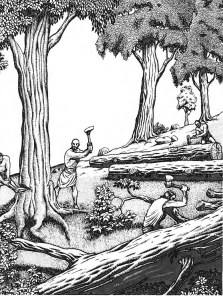
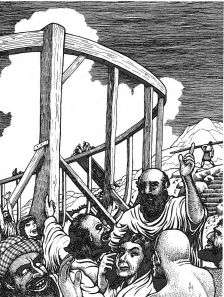
14Make for yourself an ark of gopher wood; make rooms in the ark and coat it with pitch inside and out. 15And this is how you are to build it: The ark is to be 300 cubits long, 50 cubits wide, and 30 cubits high. 16You are to make a roof for the ark, finish its walls a cubit from the top, place a door in the side of the ark, and build lower, middle, and upper decks.
17And behold, I will bring floodwaters upon the earth to destroy every creature under the heavens that has the breath of life. Everything on the earth will perish. 18But I will establish My covenant with you, and you will enter the ark—you and your sons and your wife and your sons’ wives with you.
19And you are to bring two of every living creature into the ark—male and female—to keep them alive with you. 20Two of every kind of bird and animal and crawling creature will come to you to be kept alive. 21You are also to take for yourself every kind of food that is eaten and gather it as food for yourselves and for the animals.”
22So Noah did everything precisely as God had commanded him.
Genesis 6:14–22 Commentary
The First Covenant — Sealed in Wood and Pitch:
God’s instructions for the Ark carry a solemn, binding commitment in verse 18 (Genesis 6:18) that Noah and his family will be preserved through the coming global annihilation. A cubit, in Hebrew Ammah, the unit used throughout the Ark’s dimensions, is reckoned as the distance from the elbow to the tip of the middle finger, roughly eighteen inches — making the vessel over 450 feet long, 75 feet wide, and 45 feet high. The general instruction to bring pairs of every kind of animal is expanded in our very next chapter in Genesis 7:2, which specifies seven pairs of clean animals.
Debunking the Myth That the Ark Was Too Small:
Skeptical atheists mock the Ark’s capacity, claiming it couldn’t hold millions of creatures. They fail because they confuse a biblical “kind” with a modern scientific “species.” A “kind” is closer to a genetic genus. Consider dogs: every single variety from a Chihuahua to a Saint Bernard came from one ancestral canine pair through selective breeding. Noah didn’t need every specific breed on board; he just needed the baseline genetic starters.
Genesis 6:1–2 Commentary
“Sons of God” — Angelic Beings, Not Mortal Men:
The title "sons of God" in Genesis 6:2 (in Hebrew, Benei HaElohim) refers strictly to created spiritual beings — angelic entities in the heavenly realm. While many of these celestial beings serve in the divine council, the Hebrew phrase functions as an overarching classification for supernatural spirit beings generally, who occupy diverse ranks and responsibilities across God's unseen realm. In the Hebrew Old Testament, Benei HaElohim always designates angelic beings — never mortal human men.
Job Confirms Heavenly Identity of God's Sons:
Looking ahead into the post-Flood patriarchal era, scholars widely recognize the Book of Job as the earliest written book in the biblical canon (dating linguistically and contextually to that period). In that ancient book of Job, the phrase appears in Job 1:6 and 2:1 when the sons of God present themselves before YAHWEH, and in Job 38:7 when all the sons of God shouted for joy alongside the morning stars when God laid the earth’s foundation — long before any human being existed.
Resurrected Believers Exalted Above Celestial Sons:
It is not until millennia later, under an entirely different language and covenant in the apostolic Greek of the New Testament (huioi theou), that mortal human beings are called “sons of God” — and then only when spiritually begotten through the indwelling gift of the Holy Spirit (Romans 8:14–17; 1 John 3:1–2). That contrast reveals humanity’s profound ultimate destiny: we are called to be resurrected as co-heirs with Yeshua the Messiah — THE unique, one-of-a-kind (monogenes), uncreated Son of God. Looking forward to the future resurrection at the end of the age, glorified believers will literally replace and be exalted above the former positions of the fallen sons of God, sitting with Messiah to rule the nations and judge even angels, as the Apostle Paul and the writer of Hebrews reveal (1 Corinthians 6:3; Hebrews 2:5–10).
The Biological Absurdity of the Sethite Theory:
To avoid the plain supernatural reading of Genesis 6, modern commentators often invent the “Sethite theory” — claiming the “sons of God” were merely godly male descendants of Seth, while the “daughters of men” were wicked women from Cain’s line. Think about the biological absurdity of that claim: two ordinary mortal human beings — one whose grandfather happened to be righteous and the other whose grandfather was wicked — marry, and their human union somehow produces towering warrior giants (Nephilim)?! Righteous theology does not alter human chromosomes to create gigantism.
Ancient Jewish History Unanimously Recognized Angelic Incursion:
Furthermore, throughout ancient Jewish history, this passage was never read that way. Ancient Jewish literature — including the Dead Sea Scrolls, the Septuagint (which translated it plainly as “angels of God”), Philo, and Josephus — unanimously understood Genesis 6 as an angelic incursion. Even the premier modern Jewish translation of the Hebrew Bible, the JPS Tanakh, translates Bene Elohim in Genesis 6:2 plainly as “the divine beings.” The Sethite theory is an artificial modern evasion that makes no biblical, linguistic, biological, or historical sense.
The War Over the Seed — Satan’s Genesis 3:15 Motive:
Why would these rebel angels cross this forbidden boundary in the first place? When reading Genesis 6 in the context of the overarching biblical storyline, a deeper cosmic motive emerges: the war over the Seed. Recall from earlier in our account back in Genesis 3:15, YAHWEH issued the Protoevangelium—the foundational promise that the Seed of the woman would one day crush the head of the serpent. From that moment forward, the adversary had a direct incentive to corrupt humanity’s lineage to prevent that victorious Seed from ever arriving. This incursion was quite possibly a strike where Satan coerced or influenced these angels to pollute the human line and derail the messianic promise.
Satan Remained Active While Genesis 6 Rebels Were Chained:
Crucially, Scripture gives zero indication that Satan himself physically participated in this transgression; in fact, he almost certainly did not. At most, he possibly coerced or influenced the angels who crossed that boundary. As subsequent biblical revelation discloses, the specific rebel angels who crossed the physical boundary to take human wives were ultimately locked away in chains, while Satan remained active in the spiritual realm to continue his warfare against God's plan.
The "Kind" Boundary Was Deliberately Breached:
Some try to dismiss the supernatural interpretation by pointing back to Creation Week earlier in our account in Genesis 1:24–25, where creatures reproduce "according to its kind" — the same phrase used of the animals boarding Noah's Ark — arguing that crossing such ontological boundaries was physically impossible. But Genesis 6 describes an unnatural, illicit rebellion where rebellious divine beings deliberately transgressed the order of creation. That objection actually proves the opposite point. Genesis 6 is describing exactly a world where the created order had broken down — YAHWEH looked at the whole earth and saw it corrupted, all flesh included, not just mankind. Crossing a boundary isn’t evidence the boundary was impossible to cross; it’s the corruption the chapter is describing.
Angels Can Manifest in Fully Physical Bodies:
Another skeptical objection claims spirit beings are strictly non-physical, incapable of taking wives or fathering offspring. Scripture says otherwise. In an upcoming chapter, the two angels who visit Lot in Sodom (Genesis 19) eat a physical meal, have physical hands that pull Lot inside, and are aggressively targeted for physical violation by the men of the city. Likewise, in that same upcoming narrative in Genesis 18, YAHWEH Himself appears with two angels in human bodies, eating roasted meat, curds, and bread with Abraham. Millennia later in the apostolic writings, the author of Hebrews tells believers they may have “entertained angels without knowing it” (Hebrews 13:2)—which would be impossible if angels were visible only as disembodied, glowing apparitions. Scripture describes these beings walking, eating, wrestling, and appearing indistinguishable from human men; there is no textual basis for insisting they are incapable of the physical.
1 Enoch 6:6 Records the Descent on Mount Hermon:
Genesis tells you that the sons of God came down and took human wives, but it never mentions the geographical location where they landed. Written over two millennia later, the ancient, non-inspired Second Temple Jewish book of 1 Enoch does. In 1 Enoch 6:6, the text records: "And they were in all two hundred; who descended in the days of Jared on the summit of Mount Hermon, and they called it Mount Hermon, because they had sworn and bound themselves by mutual imprecations upon it." The ancient author plays directly on the Hebrew root cherem (herem) — meaning a curse, a ban, or something devoted to destruction — to explain how Mount Hermon received its name. While 1 Enoch is uninspired Jewish historical literature rather than canonical Scripture, it provides indispensable historical context: it documents exactly how Second Temple Israelites understood the Genesis 6 event. Keep Mount Hermon firmly in mind — Scripture has an enormous amount to say about this cosmic battlefield as the biblical narrative progresses.