Genesis 43
1Now the famine was still severe in the land. 2So when Jacob’s sons had eaten all the grain they had brought from Egypt, their father said to them, “Go back, all of you, and buy us a little more food.”
3But Judah replied, “The man solemnly warned us, ‘You will not see my face again unless your brother is with all of you.’ 4If you will send our brother with us, we will go down and buy food for you. 5But if you will not send him, we will not go; for the man told us, ‘You will not see my face again unless your brother is with you.’”
6“Why did you bring this trouble upon me?” Israel asked. “Why did you tell the man you had another brother?”
7They replied, “The man questioned us in detail about ourselves and our family: ‘Is your father still alive? Do you have another brother?’ And we answered him accordingly. How could we possibly know that he would say, ‘Bring your brother here’?”
8And Judah said to his father Israel, “Send the boy with me, and we will go at once, so that we may live and not die—neither we, nor you, nor our children. 9I will guarantee his safety. You may hold me personally responsible. If I do not bring him back and set him before you, then may I bear the guilt before you all my life. 10If we had not delayed, we could have come and gone twice by now.”
Genesis 43:6–10 Commentary
Judah Stakes His Own Life for Benjamin:
When Jacob blames his sons for mentioning Benjamin (Genesis 43:6), Judah answers with blunt, practical reality. If Benjamin does not go, the entire family starves — Jacob, the brothers, and their little ones (Genesis 43:8). He points out with obvious frustration that their paralyzed arguing has already cost them enough time to make the round trip twice (Genesis 43:10). “Send the boy with me,” he insists. Rather than copying Reuben's reckless pledge from their previous standoff back in Genesis 42:37 — offering up his own sons as slaughter-bait — Judah steps forward personally, pledging to bear the blame forever if he fails to bring Benjamin home (Genesis 43:9).
The Slave Trader Becomes Benjamin’s Protector:
Six chapters earlier, Judah had engineered selling Joseph into slavery for twenty pieces of silver (Genesis 37:26–27) and joined in deceiving his father with a goat-blood soaked coat. Something profound has broken and healed inside him through the agonizing family scandals and personal humiliation recounted five chapters back in Genesis 38. The brother who once commodified a favored sibling now steps forward to stake his own life for Rachel’s remaining son. Genuine repentance produces a willingness to bear the penalty yourself.
11Then their father Israel said to them, “If it must be so, then do this: Put some of the best products of the land in your packs and carry them down as a gift for the man—a little balm and a little honey, spices and myrrh, pistachios and almonds. 12Take double the silver with you so that you may return the silver that was put back into the mouths of your sacks. Perhaps it was a mistake. 13Take your brother as well, all of you, and return to the man at once. 14May God Almighty grant all of you mercy before the man, that he may release your other brother along with Benjamin. As for me, if I am bereaved, I am bereaved.”
Genesis 43:11–14 Commentary
“If I Am Bereaved” — Jacob Relinquishes Control:
Jacob instructs his sons to take double the money and the finest produce of the land to appease the Egyptian ruler (Genesis 43:11–12). His prayer concludes with absolute surrender in Genesis 43:14: “May God Almighty grant all of you mercy before the man... As for me, if I am bereaved, I am bereaved” The patriarch who spent his life manipulating outcomes finally places his beloved son Benjamin entirely in God's hands.
Jacob’s Gift Matches the Slave Caravan’s Cargo:
Look at the inventory in verse 11 (Genesis 43:11): balm, honey, spices, myrrh, pistachios, and almonds. Go back six chapters to Genesis 37:25, where the caravan that bought Joseph was carrying spices, balm, and myrrh down to Egypt. Jacob, completely unaware, now sends those identical native products down to the very son he presumes dead. The very commodities associated with Joseph’s descent into slavery now return as tribute to the governor of Egypt. Scripture does not spell out the irony explicitly, but it lines the two lists up side by side.
15So the men took these gifts, along with double the amount of silver, and Benjamin as well. Then they hurried down to Egypt and stood before Joseph.
16When Joseph saw Benjamin with his brothers, he said to the steward of his house, “Take these men to my house. Slaughter an animal and prepare it, for they shall dine with me at noon.” 17The man did as Joseph had commanded and took the brothers to Joseph’s house.
18But the brothers were frightened that they had been taken to Joseph’s house. “We have been brought here because of the silver that was returned in our bags the first time,” they said. “They intend to overpower us and take us as slaves, along with our donkeys.”
Genesis 43:15–18 Commentary
The Brothers Assume the Worst the Moment They Enter:
The brothers hurry back to Egypt with Benjamin, bracing for the worst, but what greets them is an honor they cannot begin to fathom (Genesis 43:15). Seeing Benjamin, Joseph instructs his household steward to bring them into his private palace and slaughter an animal for a noon feast (Genesis 43:16–17) — meat being a rare, prestigious banquet dish in an ancient culture whose daily sustenance ran mostly to bread, legumes, olives, and fruit. Instead of feeling relieved, the brothers are paralyzed with dread. Led into the governor’s private residence, they assume they are being walked into an ambush: an elaborate pretext to overpower them, seize their donkeys, and enslave them over the returned silver (Genesis 43:18).
19So they approached Joseph’s steward and spoke to him at the entrance to the house. 20“Please, sir,” they said, “we really did come down here the first time to buy food. 21But when we came to the place we lodged for the night, we opened our sacks and, behold, each of us found his silver in the mouth of his sack! It was the full amount of our silver, and we have brought it back with us. 22We have brought additional silver with us to buy food. We do not know who put our silver in our sacks.”
23“It is fine,” said the steward. “Do not be afraid. Your God, the God of your father, gave you the treasure that was in your sacks. I received your silver.” Then he brought Simeon out to them. 24And the steward took the men into Joseph’s house, gave them water to wash their feet, and provided food for their donkeys.
25Since the brothers had been told that they were going to eat a meal there, they prepared their gift for Joseph’s arrival at noon.
Genesis 43:19–25 Commentary
The Steward Covers for Joseph’s Secret Test:
Desperate to clear themselves before crossing the threshold, the brothers approach the steward at the entrance and recount how they discovered their silver (Genesis 43:19–22). The steward calms them with stunning theology: “Your God and the God of your father has given you treasure in your sacks. I received your silver” (Genesis 43:23) — faithfully executing the secret orders Joseph had given him back during the brothers' first visit (Genesis 42:25). He then brings Simeon out to them, provides water to wash their feet, and feeds their donkeys, extending standard hospitality of the ancient Near East. Earlier in Genesis, Abraham had extended that exact courtesy to his three heavenly visitors (Genesis 18:4), Lot to two angels at Sodom (Genesis 19:2), and Abraham’s servant Eliezer received it from Laban in Paddan-aram (Genesis 24:32). Nearly two millennia later, Yeshua will take that ordinary hospitality and elevate it into a profound lesson in servant leadership at the Passover table (John 13:4–15).
“Eating Bread” — Ancient Hebrew Idiom for Feasting:
The brothers prepare their gift because they are told they will “eat a meal” with Joseph at noon in verse 25 (Genesis 43:25). In Hebrew, the phrase is literally to “eat bread” (le’echol-lechem) — denoting full table fellowship rather than a diet limited to baked loaves. It is the exact idiom Jacob invoked twelve chapters earlier when cutting covenant with Laban in Genesis 31:54, and the joyful wisdom Solomon echoed nearly a thousand years later during the monarchy in Ecclesiastes 9:7. Crucially, this overarching cultural idiom does not mean literal bread was absent; Yeshua Himself literally broke real loaves when reclining at table in Emmaus nearly two millennia later in Luke 24:30, even as the phrase encompasses the full shared feast.
26When Joseph came home, they presented him with the gifts they had brought, and they bowed to the ground before him.
27He asked if they were well, and then he asked, “How is your elderly father you all told me about? Is he still alive?”
28“Your servant our father is well,” they answered. “He is still alive.” And they bowed down to honor him.
29When Joseph looked up and saw his brother Benjamin, his own mother’s son, he asked, “Is this your youngest brother, the one all of you told me about?” Then he declared, “May God be gracious to you, my son.”
Genesis 43:26–29 Commentary
The Sheaves Dream Is Fulfilled Once Again:
The brothers bow to the earth as they present their gifts (Genesis 43:26), and prostrate themselves once more when answering about Jacob’s health (Genesis 43:28) — staging the exact scene they had mocked their seventeen-year-old brother for dreaming six chapters earlier back in Canaan (Genesis 37:7, 9–10). Inquiring after their elderly father, Joseph catches sight of Benjamin, his full brother by Rachel, and pronounces a blessing: “May God be gracious to you, my son” (Genesis 43:29). Calling a younger man “my son” was a customary Semitic idiom of elder authority and benevolent favor — much like the familial idiom Simeon and Levi used nine chapters earlier regarding their sister Dinah back in Genesis 34:17. In Joseph’s mouth, it perfectly shields his overwhelming brotherly love behind the formal decorum of an Egyptian ruler.
30Joseph hurried out because he was moved to tears for his brother, and he went to a private room to weep. 31Then he washed his face and came back out. Regaining his composure, he said, “Serve the meal, all of you.”
32They separately served Joseph, his brothers, and the Egyptians. (They ate separately because the Egyptians would not eat with the Hebrews, since that was detestable to them.) 33They were seated before Joseph in order by age, from the firstborn to the youngest, and the men looked at one another in astonishment.
34When the portions were served to them from Joseph’s table, Benjamin’s portion was five times larger than any of the others. So they feasted and drank freely with Joseph.
Genesis 43:30–34 Commentary
Three Dining Tables — Pagan Segregation on Display:
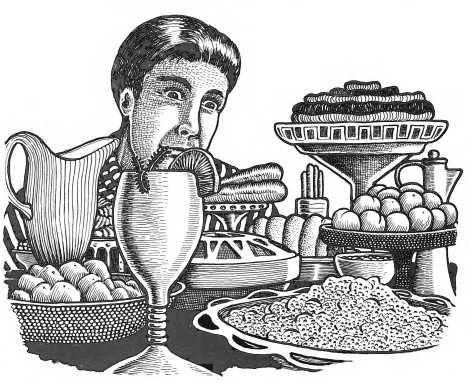
Deeply moved at the sight of Benjamin, Joseph hurries out to weep in private, washes his face, regains his composure, and orders the meal served (Genesis 43:30–31). The banquet is served across three distinct tables: Joseph dining alone, the Egyptian officials eating by themselves, and the Hebrew brothers seated at their own table (Genesis 43:32). The Egyptians refused to eat with Hebrews because dining with nomadic shepherds was considered ritually detestable — a caste prejudice three chapters ahead in Genesis 46:34 will spell out plainly. This rigid segregation is pure pagan taboo, completely foreign to the righteous character of YAHWEH.
A Fivefold Portion Tests the Brothers for Jealousy:
The brothers are seated in exact birth order, from Reuben down to Benjamin, and they look at one another in astonished disbelief (Genesis 43:33) — unable to fathom how an Egyptian ruler possesses private knowledge of their exact ages. When portions are served from Joseph’s table, Benjamin receives five times as much as anyone else (Genesis 43:34). The number five recurs deliberately throughout Joseph’s dealings with his full brother (as we will see two chapters ahead in Genesis 45:22). This lavish favoritism is an expression of Joseph’s fierce love for Rachel’s younger son, and also a calculated test: to see whether the toxic jealousy that once threw a favored brother into a pit is still alive in this family.
Genesis 43:1–5 Commentary
Bargaining Blindly With the Brother They Betrayed:
Judah reminds his father plainly of the ultimatum delivered on their first trip to Egypt: the governor made it unmistakable — no Benjamin, no audience, and certainly no grain (Genesis 42:20; 43:3–5). That mysterious imperial ruler is Joseph himself, though none of them know it yet. They are desperately pleading for their lives, completely blind to who sits on the other side of the table.