Genesis 8
1But God remembered Noah and all the animals and livestock that were with him in the ark. And God sent a wind over the earth, and the waters began to subside. 2The springs of the deep and the floodgates of the heavens were closed, and the rain from the sky was restrained. 3The waters receded steadily from the earth, and after 150 days the waters had gone down.
4On the seventeenth day of the seventh month, the ark came to rest on the mountains of Ararat.
5And the waters continued to recede until the tenth month, and on the first day of the tenth month the tops of the mountains became visible.
6After forty days Noah opened the window he had made in the ark 7and sent out a raven. It kept flying back and forth until the waters had dried up from the earth.
8Then Noah sent out a dove to see if the waters had receded from the surface of the ground. 9But the dove found no place to rest her foot, and she returned to him in the ark, because the waters were still covering the surface of all the earth. So he reached out his hand and brought her back inside the ark.
10Noah waited seven more days and again sent out the dove from the ark. 11And behold, the dove returned to him in the evening with a freshly plucked olive leaf in her beak. So Noah knew that the waters had receded from the earth.
Genesis 8:5–11 Commentary
A Year to Dry Out, Not an Overnight Miracle:
This wasn’t an overnight evaporation; it was a grueling chronological countdown that tested Noah’s endurance. After 150 days of total flooding that began back in Genesis 7:24, the waters begin their gradual recession. God “remembered Noah” — not that He had forgotten him, but that He was now acting on his behalf in covenant faithfulness.
The Olive Leaf — Enduring Symbol of Peace:
Noah releases a dove three times over the following weeks, and the fresh olive leaf it retrieves heralds healing, restoration, and a brand-new covenant world.
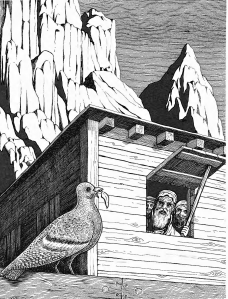
12And Noah waited seven more days and sent out the dove again, but this time she did not return to him.
13In Noah’s six hundred and first year, on the first day of the first month, the waters had dried up from the earth. So Noah removed the covering from the ark and saw that the surface of the ground was dry. 14By the twenty-seventh day of the second month, the earth was fully dry.
15Then God said to Noah: 16“Come out of the ark, you and your wife, along with your sons and their wives. 17Bring out all the living creatures that are with you—birds, livestock, and everything that crawls upon the ground—so that they can spread out over the earth and be fruitful and multiply upon it.”
Genesis 8:17 Commentary
“Be Fruitful and Multiply” — Humanity’s Fresh Start:
This divine command deliberately echoes God’s words to Adam and Eve back in Genesis 1:28, presenting Noah’s family as a genuine new beginning for the human race.
18So Noah came out, along with his sons and his wife and his sons’ wives. 19Every living creature, every creeping thing, and every bird—everything that moves upon the earth—came out of the ark, kind by kind.
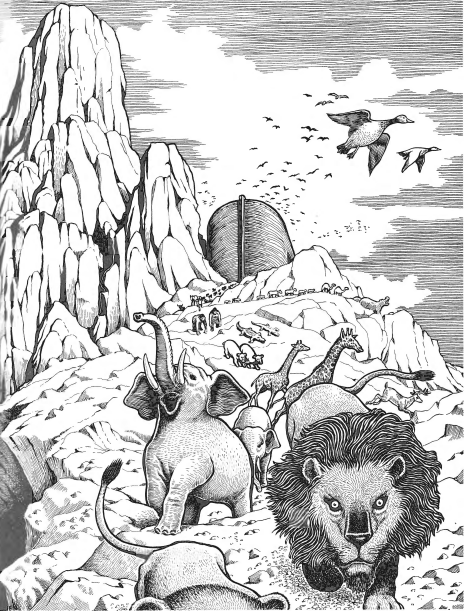
20Then Noah built an altar to YAHWEH. And taking from every kind of clean animal and clean bird, he offered burnt offerings on the altar. 21When YAHWEH smelled the pleasing aroma, He said in His heart: “Never again will I curse the ground because of man, even though every inclination of his heart is evil from his youth. And never again will I destroy all living creatures as I have done.
22As long as the earth endures: Seedtime and harvest, cold and heat, summer and winter, day and night shall never cease.”
Genesis 8:20–22 Commentary
No Temple Yet — Altars Built Wherever Noah Stood:
Noah’s first recorded act on dry ground is to build an altar and offer sacrifices. In this era, worship required no central tabernacle or stone temple; the patriarch simply called upon God where he stood. God accepts only clean animals for sacrifice, a foundational principle that stands in sharp contrast to the recurring “abominations of desolation” that the prophet Daniel foretold nearly two millennia later (Daniel 11:31), and the infamous desecration centuries after Daniel during the intertestamental period (1 Maccabees 1:47, 54) — where Antiochus IV Epiphanes sacrificed swine on the altar before the Messiah’s return.
A Pleasing Aroma, While Swine Remain Detestable:
God smells a “pleasing aroma” from Noah’s offering, in stark contrast to swine, which the prophet Isaiah nearly two millennia later labels an abomination even in his description of the final judgment before the Messiah’s return (Isaiah 66:17).
“Soothing Aroma” Shares Its Root With Noah’s Name:
Genesis 8:21 says YAHWEH smelled a pleasing aroma, and the Hebrew is re'ach ha-nichoach, a “soothing” or “restful” aroma. Nichoach comes from the same root as Nuach, “rest,” and Noach, Noah’s own name, means “rest” — recalling from earlier in our account in chapter 5 how his father Lamech named him hoping he would bring relief from the cursed ground (Genesis 5:29). The same root shows up when the Ark “came to rest” on the mountains of Ararat (Genesis 8:4), and now it shows up a third time: a man named Rest, off an Ark that came to rest, offers a sacrifice that is a restful aroma to God. In response, YAHWEH moderates the original curse He had placed on the ground through Adam back in Genesis 3:17 — not lifting it entirely, but softening its weight and promising never again to strike every living creature as He had done.
The Flood Washed the Earth, Not the Human Heart:
Compare this with the pre-Flood diagnosis back in Genesis 6:5: there, the inclination of man’s heart was evil all the time. Here in Genesis 8:21, after the Flood has wiped the earth clean, God notes that man’s heart is still “evil from his youth.” The catastrophic deluge cleansed the physical globe, but it did not purge the fallen human nature inherited from Adam. The problem of sin required an inward spiritual transformation that only the promised Redeemer could provide.
Genesis 8:1–4 Commentary
God Works Miracles Through Natural Means:
Nearly a thousand years later at the Exodus, God will similarly use an east wind to part the Red Sea (Exodus 14:21), just as He uses a wind here to begin subsiding the floodwaters. This is a recurring pattern in Scripture: grounding the miraculous in the natural world rather than setting it apart from it.
The Same Two Flood Sources Now Get Reversed:
In Genesis 8:2, the closing of the “floodgates of the heavens” and the halting of torrential rain are recorded as two distinct physical events. When “the fountains of the deep” were shut down, it wasn't some figurative poetic valve: the Almighty halted catastrophic subterranean upwelling and stabilized the fractured crust of the earth, allowing the raging global floodwaters to recede into deep ocean basins.
The Ark Lands on the Mountains of Ararat:
The vessel eventually comes to rest in the rugged highlands of Ararat, situated in the region of modern-day Turkey and Armenia.