Genesis 9
1And God blessed Noah and his sons and said to them, “Be fruitful and multiply, and fill the earth, all of you. 2The fear and dread of you will fall on every living creature on the earth, every bird of the air, every creature that crawls on the ground, and all the fish of the sea. They are delivered into your hands. 3Everything that lives and moves will be food for all of you; just as I gave you the green plants, I now give all of you everything. 4But you must not eat meat with its lifeblood still in it.”
5“And surely I will require the life of any man or beast by whose hand your lifeblood is shed. I will demand an accounting from anyone who takes the life of his fellow man:
6Whoever sheds the blood of man,
by man his blood will be shed;
for in His own image God has made mankind.”
Genesis 9:5–6 Commentary
Life for Life — God Mandates Civil Accountability:
Before the Flood, violent men shed blood with total impunity. As recorded earlier in Genesis 4, Cain murdered his brother Abel, and Lamech openly bragged about killing a man for merely wounding him (Genesis 4:23–24). The ancient world descended into utter chaos because lawless bloodshed ran unchecked. Here in Genesis 9, God establishes a foundational covenant principle: “Whoever sheds the blood of man, by man his blood will be shed.” God mandates life for life because the wages of sin is death, and to prevent the earth from descending into another endless cycle of Cain-and-Abel blood feuds. By establishing civil justice, God took retaliation out of private hands, putting a hard stop to personal vigilantism and lawless revenge. As a standing biblical principle — one the Apostle Paul makes unmistakably clear millennia later under the New Covenant in Romans 12:19—vengeance belongs exclusively to God: “Do not avenge yourselves, beloved, but leave room for God’s wrath. For it is written: ‘Vengeance is Mine; I will repay, says the Lord.’” In God’s universe, life must answer for life — a righteous standard of divine justice that sets the stage for the ultimate redemption to come.
Life for Life Fulfilled — Yeshua Nailed Our Debt to the Cross:
But notice the profound spiritual truth pointing directly to redemption: in God's universe, life must answer for life. As the Apostles John and Paul would explain millennia later in the New Covenant Scriptures, because sin is the transgression of God's Law (1 John 3:4) and "the wages of sin is death" (Romans 6:23), every one of us owed a debt we could never pay. Divine justice could not simply overlook our guilt. But that is the glorious reality of the Gospel! On the cross, Yeshua the Messiah offered Himself as our Passover Lamb, taking our penalty upon Himself. As the Apostle Paul reveals in Colossians 2:13–14, He wiped out our certificate of debt, nailing the penalty of our sins to the cross. God's righteous standard requires that life answers for life, and on the cross, Yeshua gave His life to redeem ours.
The Reason Given Is God’s Image, Not Revenge:
Verse 6 (Genesis 9:6) spells out why murder carries this penalty: “for in the image of God has God made mankind.” That is the same divine image, tzelem, introduced back in Genesis 1:26–27. Taking a human life is an attack on the Creator whose image that human bears. Requiring life for life when murder is committed is instituted here as a permanent, universal covenant principle for all humanity, not merely a temporary statute for ancient Israel. Yet under the New Covenant, believers do not exact life for life — not because God’s moral law has changed, but because Yeshua paid the ultimate price, dying the death that the wages of sin demanded. He died for all mankind so that everyone who believes in Him could live.
7“As for all of you, be fruitful and multiply; spread out across the earth and multiply upon it.”
8Then God said to Noah and his sons with him: 9“Behold, I now establish My covenant with all of you and with your descendants after you, 10and with every living creature that was with all of you—the birds, the livestock, and every beast of the earth—every living thing that came out of the ark: 11And I establish My covenant with all of you: Never again will all life be cut off by the waters of a flood; never again will there be a flood to destroy the earth.”
12And God said, “This is the sign of the covenant I am making between Me and all of you and every living creature with you, a covenant for all generations to come: 13I have set My rainbow in the clouds, and it will be a sign of the covenant between Me and the earth.
Genesis 9:8–13 Commentary
An Unconditional Promise, With No Demands on Noah:
God establishes a covenant that He will never again destroy the whole earth by a Flood, regardless of humanity’s future wickedness — initiated entirely by God Himself, without demanding any reciprocal performance from Noah or his descendants. The rainbow is given as the sign of this covenant, which some take as support for the idea that rain, or at least a rainbow-producing atmosphere, did not exist in the same way before the Flood, consistent with our earlier account back in Genesis 2:5 where YAHWEH had not yet caused it to rain upon the earth.
The Hebrew for “Set” Fits a Brand-New Rainbow:
Behind “set” in verse 13 (Genesis 9:13) is the Hebrew verb nathan, the everyday word for “give,” “put,” or “place.” While the word itself doesn’t prove the optical phenomenon was brand new — God often assigns an existing part of creation a new covenant role — it fully accommodates the idea that this was the first rainbow human eyes had ever seen.
Three Explanations for Earth's First Visible Rainbow:
If that’s right, and this really was the first rainbow anyone had ever seen, three plausible explanations are on the table: first, the Almighty could have altered the optical laws of physics governing light refraction; second, rain itself may have never fallen prior to the Deluge — as recorded earlier during Creation in Genesis 2:5–6, a rising mist originally watered the earth, meaning falling raindrops and storm clouds were themselves a brand-new post-Flood atmospheric reality; or third, God permanently altered the atmosphere by collapsing the pre-Flood upper water canopy — the very “waters which were above the expanse” back in Genesis 1:7 that emptied during the forty days of relentless downpour.
God’s War Bow Hung in the Clouds:
Look at what the Hebrew actually calls it. In your English Bible verse 13 (Genesis 9:13) says “My rainbow,” but the Hebrew word is qeshet, the ordinary word for a bow, the kind you shoot arrows with, and the verse literally says “My bow.” Picture it. After a judgment that wiped out the earth, the Warrior sets His bow in the clouds, hung up where everyone can see it. Nearly two millennia later, the Old Testament prophets would take up this very imagery: Habakkuk 3:9 pictures YAHWEH uncovering His bow when He marches to war, while the prophet Zechariah foresees that bow of battle cut off when the Messiah comes as King to speak peace to the nations (Zechariah 9:9–10). The rainbow is God hanging up His weapon and pointing it away from the earth.
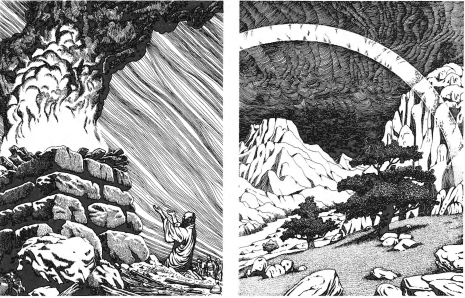
14Whenever I form clouds over the earth and the rainbow appears in the clouds, 15I will remember My covenant between Me and all of you and every living creature of every kind. Never again will the waters become a flood to destroy all life. 16And whenever the rainbow appears in the clouds, I will see it and remember the everlasting covenant between God and every living creature of every kind that is on the earth.”
17So God said to Noah: “This is the sign of the covenant that I have established between Me and every creature on the earth.”
18The sons of Noah who came out of the ark were Shem, Ham, and Japheth. And Ham was the father of Canaan. 19These three were the sons of Noah, and from them the whole earth was populated.
20Now Noah, a man of the soil, proceeded to plant a vineyard. 21But when he drank some of its wine, he became drunk and uncovered himself inside his tent.
Genesis 9:18–21 Commentary
Japheth Listed Youngest, and Canaan Named Early:
This genealogy confirms Japheth as the youngest of Noah’s sons, while specifically singling out Canaan under Ham’s lineage — a detail that becomes essential just a few verses later.
Noah Wasn’t Sinless — Wine Itself Isn’t Banned:
The patriarch was by no means immune to sin: he plants a vineyard, drinks its wine, and becomes drunk within his tent. Scripture nowhere prohibits alcohol itself, only drunkenness — a standard the Apostle Paul would make explicit millennia later in Ephesians 5:18: “do not get drunk on wine, which leads to reckless indiscretion”
Noah as a Second Adam — Eden’s Pattern Replayed:
Step back and notice the pattern. Noah is called a “man of the soil,” in Hebrew ish ha-adamah, a man of the ground, a phrase that echoes Adam, taken from the adamah and set to work the ground. He plants a vineyard, drinks what it produces, and ends up uncovered and ashamed, with a curse following close behind. That is Eden’s sequence replayed with a vineyard. As established just one chapter earlier, Genesis 8:21 already told us why: the Flood reset the world, but not the heart. Noah gets the fresh start Adam got, and right away the old problem shows up again, this time in a tent instead of a garden.
22And Ham, the father of Canaan, saw his father’s nakedness and told his two brothers outside.
23Then Shem and Japheth took a garment and placed it across their shoulders, and walking backward, they covered their father’s nakedness. Their faces were turned away so that they did not see their father’s nakedness.
24When Noah awoke from his drunkenness and learned what his youngest son had done to him, 25he said, “Cursed be Canaan!
A servant of servants shall
he be to his brothers.”
Genesis 9:22–25 Commentary
The Text Points to Canaan, Not Ham:
Though Noah was asleep or incapacitated at the time, he later “knew what his youngest son had done.” That phrasing singles out Canaan (Ham’s youngest son, as the upcoming Table of Nations in our very next chapter lists him in Genesis 10:6) rather than Ham (Noah’s middle child). The act itself went beyond mere accidental sight, involving conscious, deliberate intent — whether sexual transgression, public humiliation, or physical violation — carried out by a grandson old enough to bear the full weight of the curse.
Years Passed Before This Happened, Not a Few Days:
Keep the timeline straight here: this sordid event didn’t happen the Friday after they stepped off the Ark. Years have passed. Noah had to have time to establish himself as a husbandman, plant a vineyard, wait years for the vines to mature, harvest the grapes, and ferment the wine. More importantly, enough time had passed for Noah’s grandsons to be born and grow old enough to act with conscious, accountable intent. While Scripture does not explicitly confirm that Canaan had reached full adulthood, he was certainly no innocent child — he was plenty old enough to know right from wrong, likely at least a teenager, and morally responsible for what he chose to do.
Leviticus 18 Condemns Canaan for These Same Sins:
Nearly a thousand years later at Mount Sinai, the Holiness Code in Leviticus 18:6–19 catalogs forbidden sexual unions, explicitly warning Israel not to copy the depraved practices that had come to define Canaan (Leviticus 18:3). God was not condemning an isolated individual here, but the collective nation of Canaan — the pagan tribes descended from this patriarch whose systemic depravity would eventually bring divine judgment upon the entire land.
26He also declared:
“Blessed be YAHWEH, the God of Shem!
May Canaan be the servant of Shem.
27May God expand the territory of Japheth;
may he dwell in the tents of Shem,
and may Canaan be his servant.”
28After the flood, Noah lived 350 years. 29So Noah lived a total of 950 years, and then he died.
Genesis 9:25–28 Commentary
The Curse on Canaan Never Justifies Slavery:
This prophetic judgment fell specifically on Canaan, not Ham, and by no means established chattel slavery as God’s design for humanity — a principle underscored nearly a millennium later in Deuteronomy 23:15–16 (“Do not return a slave to his master... do not mistreat him”), and demonstrated millennia later in the Apostolic era by Paul’s appeal in Philemon, where he pleads for Onesimus to be received in mercy as a beloved brother.
Shem Carries the Covenant Line to Abram:
Shem, in the aftermath, continues the righteous line after the Flood much as Seth had continued it before the Flood, eventually leading to Abram and the covenant people descended from him. Two chapters ahead, Genesis 11:10 picks up this same line directly, opening the genealogy from Shem down to Abram. Jewish tradition sometimes identifies Shem with Melchizedek (in Hebrew, Melek Tzedek, “King of Righteousness”), who appears five chapters ahead in Genesis 14:18–20, and the chronology of the genealogies makes this mathematically possible. It is far more likely, as the New Testament Epistle to the Hebrews would argue millennia later in Hebrews 7:3, that Melchizedek is better understood as a pre-incarnate appearance of the Messiah Himself.
Genesis 9:1–4 Commentary
Mankind Carries Dominion, Animals Now Fear Us:
This dread among beasts dates from the Flood covenant, even while humanity retains its original creation commission as image-bearers of God.
“Everything That Lives” Was Never a Blank Check:
The text seems to permit the eating of “every moving thing that lives,” but this is not a blanket statement allowing absolutely anything as food. Genesis 9:4 immediately restricts the eating of blood, and nearly a thousand years later at Mount Sinai, the Law in Leviticus 11:2–23 will add detailed clarification. Noah, as already noted, understood the distinction between clean and unclean animals well before this point. Humans themselves are technically “moving things that live,” yet obviously fall outside the intended category. Scripture has to be read as a coherent whole, not through isolated phrases lifted out of context.
The Unbroken Prohibition Against Eating Blood:
The prohibition on eating blood holds constant before Sinai, under the Sinai covenant, and after Yeshua’s sacrifice. Nearly a thousand years later in the Torah, Leviticus 17:14 forbids eating the blood of any creature — “you shall not eat the blood of any creature, for the life of every creature is its blood” — and more than two millennia after Noah at the Jerusalem Council, Acts 15:28–29 instructs new Gentile believers to “abstain from… what has been strangled, and from blood” as well.
The Council of Florence Altered Biblical Dietary Law:
Fast-forward more than three millennia to church history: it was the Council of Florence in 1442, under Pope Eugene IV, claiming the title “Vicar,” or substitute, of the Messiah, that declared all foods permissible and abolished the prohibition on blood, directly conflicting with these standing biblical prohibitions and with Moses' warning given nearly a thousand years after the Flood in Deuteronomy 4:2 against adding to or taking away from God’s commands. Down through the prophets and into the New Covenant, the prophet Malachi nearly two millennia later (Malachi 3:6) — “I YAHWEH do not change” — and the apostolic Epistle to the Hebrews (Hebrews 13:8) — “Yeshua the Messiah is the same yesterday and today and forever” — both testify, across two different Testaments, that God and His Messiah do not change.