Genesis 10
1This is the account of Noah’s sons Shem, Ham, and Japheth, who also had sons after the flood.
2The sons of Japheth: Gomer, Magog, Madai, Javan, Tubal, Meshech, and Tiras.
Genesis 10:2 Commentary
One Name Stops Us — Magog:
As Japheth’s sons open the list, Magog demands immediate attention. Nearly two millennia down the timeline of prophecy, the prophet Ezekiel (Ezekiel 38:1–39:29) isn’t writing vague poetry — he describes a massive end-time invasion led by “Gog, of the land of Magog,” coming, in Ezekiel’s own words, “from your place out of the far north… you and many peoples with you” (Ezekiel 38:15). The first-century Jewish historian Josephus, in his Antiquities of the Jews (1.6), identified the Magogites as the Scythians — the fierce horse peoples who roamed the northern Eurasian steppe. Bible students have long tracked that northern steppe geography straight to the regions now occupied by Russia and Central Asia. Don’t pin that to a map with surgical precision, but don’t miss it either — this name sets a trajectory that runs clean through the rest of the prophetic record.
Ancient Names Still Map End-Times Power Blocs:
Here is the key to these ancient lists: the further down the lineage you go, the tighter the cultural and political ties become. When the Almighty blows the whistle on the end times, He doesn’t check modern passports — He calls these power blocs by their original family names. The prophet Ezekiel’s end-times vision recorded over seventeen centuries later (Ezekiel 38:2–6) proves it: the coalition marching with Gog is listed by names straight out of this chapter — Magog, Meshech, and Tubal, Gomer and Beth-Togarmah, and from Ham’s line, Cush and Put (Genesis 10:2–3, 6). Four thousand years of history haven’t altered international relations one bit; the final global chessboard is going to line up exactly along these ancient clan bloodlines.
3The sons of Gomer: Ashkenaz, Riphath, and Togarmah.
4And the sons of Javan: Elishah, Tarshish, the Kittites, and the Rodanites. 5From these, the maritime peoples separated into their territories, according to their languages, by clans within their nations.
6The sons of Ham: Cush, Mizraim, Put, and Canaan.
7The sons of Cush: Seba, Havilah, Sabtah, Raamah, and Sabteca. And the sons of Raamah: Sheba and Dedan.
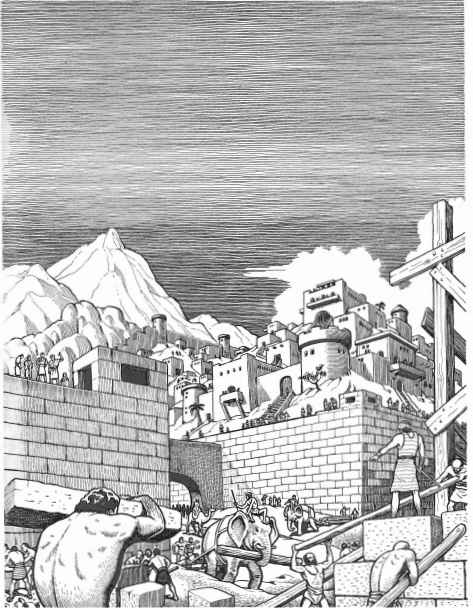
8Cush was the father of Nimrod, who began to be a mighty one on the earth. 9He was a mighty hunter in defiance of YAHWEH (so it is said, “Like Nimrod, a mighty hunter in defiance of YAHWEH”). 10His kingdom began in Babylon, Erech, Accad, and Calneh, in the land of Shinar. 11From that land he went forth into Assyria, where he built Nineveh, Rehoboth-Ir, Calah, 12and Resen, which is between Nineveh and the great city of Calah.
Genesis 10:6–12 Commentary
Ham’s Sons — From Cush Down to Canaan:
This branch begins with Cush (tied consistently to Ethiopia and Nubia), passes through Mizraim (Egypt) and Put, and culminates in Canaan — remember that last name, because the fallout from Noah's curse back in Genesis 9 is about to play out in real history through this exact son.
Nimrod — A “Mighty Hunter” in Defiance of God:
In Genesis 10:8–9, Cush fathers Nimrod, whom Scripture designates as the first “mighty one on the earth” — a predatory ruler hunting in open defiance of YAHWEH. Most English Bibles soften this as hunting “before YAHWEH,” which modern readers easily mistake for divine approval. But in biblical Hebrew, standing lifnei YAHWEH carries an adversarial edge: acting right in the face of the Almighty with arrogant defiance. Nimrod channeled that rebel energy into building the first post-Flood empire — Babel, Erech, Accad, and Calneh in Shinar, eventually expanding into Assyria and Nineveh. Every subsequent biblical indictment of Babylon as the throne of cosmic rebellion traces straight back to this man.
Micah Aims Judgment at Nimrod’s Old Territory:
Over fifteen centuries later during the prophetic era, the prophet Micah foretells that the Messiah’s people will rule “the land of Assyria with the sword, and the land of Nimrod with the blade drawn” (Micah 5:6) — conquering the very kingdom this ancient rebel first established.
Nimrod’s Title Echoes the Mighty Men of Genesis 6:
The word for “mighty one” in Genesis 10:8 is gibbor, and it is the same word family as gibborim, the “mighty men of old” whom our account previously introduced four chapters earlier in Genesis 6:4. Nimrod was not merely a skilled physical archer; he was an aggressive imperialist who began to establish an autocratic empire in open rebellion against YAHWEH’s command to disperse.
13Mizraim was the father of the Ludites, the Anamites, the Lehabites, the Naphtuhites, 14the Pathrusites, the Casluhites (from whom the Philistines came), and the Caphtorites. 15And Canaan was the father of Sidon his firstborn, and of the Hittites, 16the Jebusites, the Amorites, the Girgashites, 17the Hivites, the Arkites, the Sinites, 18the Arvadites, the Zemarites, and the Hamathites. Later the Canaanite clans were scattered, 19and the borders of Canaan extended from Sidon toward Gerar as far as Gaza, and then toward Sodom, Gomorrah, Admah, and Zeboiim, as far as Lasha.
20These are the sons of Ham according to their clans, languages, lands, and nations.
21And sons were also born to Shem, the older brother of Japheth; Shem was the forefather of all the sons of Eber.
22The sons of Shem: Elam, Asshur, Arphaxad, Lud, and Aram.
23The sons of Aram: Uz, Hul, Gether, and Mash.
24Arphaxad was the father of Shelah, and Shelah was the father of Eber.
25Two sons were born to Eber: One was named Peleg (because in his days the earth was divided), and his brother was named Joktan.
26And Joktan was the father of Almodad, Sheleph, Hazarmaveth, Jerah, 27Hadoram, Uzal, Diklah, 28Obal, Abimael, Sheba, 29Ophir, Havilah, and Jobab. All these were sons of Joktan. 30Their territory extended from Mesha to Sephar, in the eastern hill country.
31These are the sons of Shem, according to their clans, languages, lands, and nations.
32All these are the clans of Noah’s sons, according to their generations and nations. From these the nations of the earth spread out after the flood.
Genesis 10:21–32 Commentary
Shem’s Genealogy Outweighs All Others in Genesis:
The chapter closes with Shem’s descendants, the pivotal bloodline that anchors the entire book — running straight into the upcoming toledot of Genesis 11:10 and leading directly to Abram.
Peleg — A Datable Fracture in Human History:
Genesis 10:25 records that Peleg’s name literally means “division,” giving the explicit historical reason: “for in his days the earth was divided.” While this text absolutely refers to the linguistic and territorial fracture at Babel in the very next chapter, it may also — and this is strictly a possibility — be referencing the physical splitting of Pangea, the original single supercontinent where all landmasses were joined. It is possible that both catastrophic divisions transpired during this exact same generational window. Modern secular geologists insist continental drift required hundreds of millions of years, but that uniformitarian model ignores the catastrophic power of the Creator. God may have orchestrated a rapid, violent separation of the tectonic plates through unprecedented seismic activity during this era, after which plate movement decelerated to the slow drift of an inch or two per year that we measure today. Either way, the biblical text firmly anchors this momentous fracture at a named, datable generation in real human history.
Genesis 10 Assumes Babel — Mind the Timeline:
Genesis 10 describes the world after Babel’s languages were already divided; the nations here are listed by families, languages, lands, and tongues (Genesis 10:5, 20, 31), which is exactly the outcome Babel produces in the very next chapter. Moses works from an ordered family record here. Flatten Genesis 10 and 11 into one straight timeline and you’ll walk away confused for no good reason.
Genesis 10:1 Commentary
All Humanity Traces Back to Three Brothers:
Moses structures this table as a formal clan list, cataloging exactly seventy foundational nations descended from the three brothers who walked off Noah’s Ark. Using a strict father-son-grandson blueprint to map out deep geopolitical connections, this record holds immense prophetic weight. Nearly a thousand years later on the plains of Moab, Moses in Deuteronomy 32:8 ties the division of the nations to the number of the sons of God, and fast-forwarding over two millennia to the Gospels, the Majority Text of Luke 10:1 records Yeshua appointing seventy disciples to go out ahead of Him. We’ll take up that cosmic scattering in our very next chapter at Babel in Genesis 11.
Genesis 10 — Historical Toledot, Not Myth:
Here Moses presents the toledot — the authentic family register — of Shem, Ham, and Japheth, the three sons of Noah who repopulated the entire earth after the Flood. The first-century Jewish historian Josephus, in his Antiquities of the Jews (1.6), reads the table this way...